
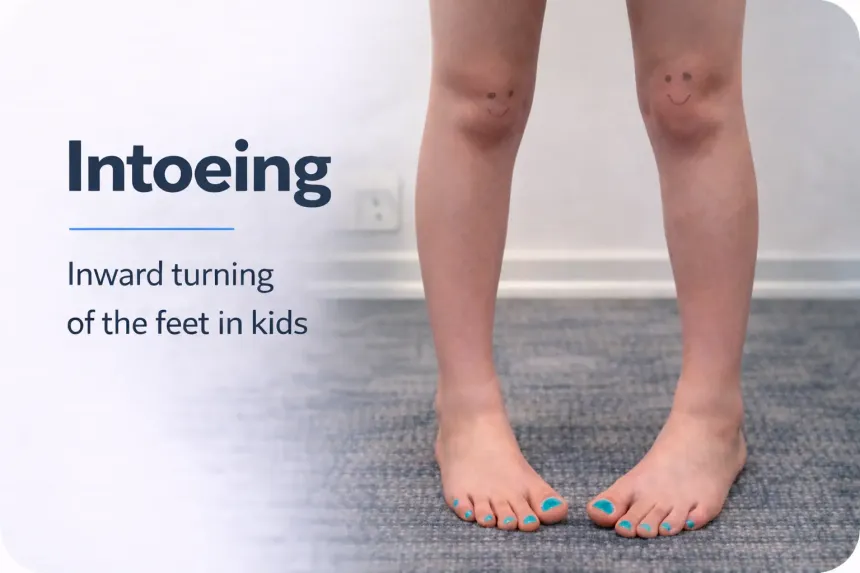

If you’ve caught yourself watching your pigeon-toed toddler cross the living room and thinking “why do their feet turn in like that,” you’re not imagining it, and you’re not the only parent Googling it at 11pm. This is one of the most common things parents notice and worry about, and most of the time it’s a completely normal part of how kids’ legs and feet develop. Here’s how to tell the difference between normal and worth a closer look.
Is It Normal for My Toddler to Walk Pigeon-Toed?
In most toddlers and young children, walking with the feet turned in (in-toeing) is a normal, temporary part of development, not a problem that needs to be fixed. It’s related to how a child’s leg bones are still rotating and straightening as they grow, and for most kids it improves on its own with no treatment at all.
That said, “usually normal” doesn’t mean “never worth checking.” A quick evaluation can tell you which one you’re dealing with, and take the guesswork out of it.
Why Is My Child Tripping Over Their Own Feet?
Tripping is often the thing that actually gets a parent’s attention, more than the turned-in look itself. When a child’s feet point inward, their toes can catch on the ground or on the opposite foot mid-stride, which shows up as frequent tripping, stumbling, or an awkward-looking run.
This tripping tends to be most noticeable when a child is moving fast, running across a room or a playground, rather than during a slow, careful walk. Most kids grow out of the tripping phase along with the in-toeing itself as their legs continue to develop.
What Causes In-Toeing and Out-Toeing?
In-toeing and out-toeing come from where the “twist” is happening along the leg, and it’s normal for this to shift as a child grows:
- In babies and infants, in-toeing is often related to the position of the foot itself (metatarsus adductus), sometimes from how the baby was positioned in the womb.
- In toddlers around 1 to 3 years old, in-toeing is most commonly related to inward twisting of the shin bone (tibial torsion).
- In older children, roughly 4 to 8 years old, in-toeing more often comes from the thigh bone (femoral anteversion), which can also show up as a child who sits in a “W” position on the floor.
- Out-toeing (feet pointing outward) is less common but follows a similar pattern, related to rotation higher up in the hip or leg rather than the foot itself.
None of these are caused by anything a parent did or didn’t do. They’re part of how the bones and joints in a growing leg gradually rotate into their adult alignment, and that rotation happens on its own timeline for every child.
Not sure if your child is in-toeing or walking on their toes? They’re two different things. In-toeing is about which direction the feet point, while toe walking is about how the foot lands with each step. If your child walks up on the balls of their feet, read our guide to toe walking in children.
Will In-Toeing Go Away on Its Own?
For most children, in-toeing improves gradually and resolves without any treatment, typically by the time they’re around 8 to 10 years old, sometimes much earlier. Bracing, special shoes, and shoe inserts have not been shown to speed up this natural rotation, which is why watchful waiting, not intervention, is the standard first approach for straightforward cases.
The exception is when in-toeing or out-toeing doesn’t fit that typical pattern, which is where an evaluation matters.
When Should I Worry About My Child’s Walk?
It’s worth scheduling an evaluation, rather than just waiting it out, if any of the following are true:
- The in-toeing or out-toeing is severe, or it’s getting worse rather than better over time
- It’s only on one side, rather than affecting both legs evenly
- Your child is in noticeable pain, or seems to favor one leg
- Your child is past the age where in-toeing usually resolves (roughly 8 to 10) and it hasn’t improved
- Frequent falling is significantly affecting your child’s confidence or willingness to run and play
- You just want a professional opinion instead of guessing from home
A pediatric foot and ankle evaluation is quick, and it gives you a clear answer either way: reassurance that it’s a normal developmental stage, or a plan if it’s not.
How Is In-Toeing or Out-Toeing Evaluated?
An evaluation typically starts with watching your child walk and run, and a hands-on exam checking hip, knee, and foot rotation to identify where along the leg the rotation is coming from. This helps determine whether it’s coming from the foot, the shin, or the thigh bone, which matters because the expected timeline and the (rare) treatment options differ depending on where it originates. X-rays are not usually needed for typical in-toeing, since this is primarily a hands-on, observational diagnosis.
Pediatric In-Toeing Evaluations in Chandler and Power Ranch, AZ
Dr. Mikkel Jarman, DPM, FACFAS and Dr. Nicole Baxter, DPM, FACFAS see young patients under 18 years old for in-toeing foot conditions. You can book an appointment at either one of our local offices, one located in Chandler, AZ and the other in Gilbert, AZ. At your first appointment we will need to verify first your insurance, payment options and/or referral documentation. Our front desk will contact you to verify and help guide you every step of the way with this information. If you have any questions please give us a call at (480)-534-7220.
Key Takeaways
- In-toeing (pigeon-toed walking) is a normal, common part of development in most toddlers and young children, and it usually resolves on its own with no treatment.
- Frequent tripping is often what parents notice first, and it tends to improve along with the in-toeing as a child’s legs continue developing.
- Where the rotation is coming from (foot, shin, or thigh bone) tends to shift with age, and that’s a normal pattern, not a sign of multiple problems.
- Most in-toeing resolves by around age 8 to 10, and bracing or special shoes have not been shown to speed this up.
- Babies with a stiff, curved foot (metatarsus adductus) benefit from an early look.
- An evaluation is worth scheduling if it’s severe, one-sided, painful, worsening, or hasn’t improved by the age it typically resolves.
Frequently Asked Questions
Is pigeon-toed walking bad for my child?
No. In most children, pigeon-toed walking (in-toeing) is a normal developmental stage related to how the leg bones are still rotating. It doesn’t cause long-term problems or need correction in typical cases.
Do special shoes or inserts fix in-toeing?
No. Bracing, corrective shoes, and shoe inserts have not been shown to speed up the natural rotation that resolves in-toeing. Most cases improve on their own with time.
At what age should in-toeing be gone?
Most in-toeing resolves by around age 8 to 10, though many children improve much earlier. If it hasn’t improved by then, or if it’s severe, one-sided, or painful, it’s worth an evaluation.
Why does my child sit in a “W” position?
Sitting in a “W” position (knees bent, feet out to the sides) is common in children whose in-toeing comes from the thigh bone (femoral anteversion). It often improves along with the in-toeing as they grow.
Should I be worried if only one of my child’s feet turns in?
In-toeing or out-toeing on one side only is less typical than a pattern that affects both legs evenly. It’s a good reason to schedule an evaluation so a specialist can check the cause.
Can in-toeing cause my child to fall a lot?
Yes. Tripping and falling are common in children with in-toeing, especially while running, and this usually improves as the in-toeing resolves with growth.
Is pigeon-toed walking the same as toe walking?
No. Pigeon-toed walking means the feet point inward. Toe walking means a child walks on the balls of their feet without their heels touching the ground. They have different causes, and a child can have one without the other. Learn more about toe walking in children.
Schedule an Evaluation at our Chandler and Power Ranch, AZ offices
If you have any questions please give us a call at (480)-534-7220. Or visit our website to request an appointment or book online via zocdoc portal.


