
Pediatric In-Toeing (Pigeon Toes)
Symptoms, Causes and Treatment of Pigeon Toes / In-Toeing in Children
What Is Intoeing?
When a child’s feet point inward instead of straight, it is known as intoeing. Also known as being pigeon toed, the condition is fairly common, and mild cases will generally resolve on their own.
However, not all cases fall into the “mild” category, and early interventional treatment is recommended, especially when identified in infancy with no noticeable improvement over a period of time.
Your child may start out walking this way or the condition may develop at a later date. Intoeing is painless. However, pain may be associated with the issue that caused the condition.
An Overview of Pediatric Intoeing by Dr. Jarman
What Causes Intoeing?
"Intoeing creates a lot of parental concerns and is a very common torsional gait abnormality I see almost every day here in the office. Intoeing is a visual effect of an underlying torsional twisting deformity coming from the lower extremities."
Dr. Mikkel Jarman
There are three influencing areas of origin, and the classifications are:
- Femoral Anteversion – originates from a torsional pull from the hips, causing the child’s knees and feet to turn inward and have a “pigeon-toed” appearance.
- Tibial Torsion – originates from a torsional pull from the lower legs (shinbone), causing the child’s legs and feet to turn inward.
- Metatarsus Adductus – originates from the feet, the front half or forefoot, and is a common foot deformity typically visible at birth.
(Read on for a more detailed overview of each classification below.)

The 3 Main Intoeing Classifications
Femoral anteversion
The inward turning of the thighbone, known as femoral anteversion, does not usually become obvious until the child reaches school age. The condition nearly always corrects itself by the age of 9 or 10.
This is another instance where conservative treatment does not correct the issue. If your child has femoral anteversion coupled with severe deformity or gait issues, surgery may be considered after age 10. It requires cutting the femur (thigh bone) to rotate it to the correct position.

Tibial torsion
If the lower leg twists inward, this is known as tibial torsion. The condition typically improves gradually, with normal alignment occurring by the time the child starts school.
Tibial torsion does not respond to conservative treatment, e.g. splints, physical therapy, or special footwear. If the child reaches their eighth birthday without improvement and experiences significant walking problems, your podiatrist may recommend surgery. This involves rotating the shin bone to its proper position.
Metatarsus adductus
In a child with metatarsus adductus, the foot bends inward from the midpoint to the toes. The condition may be mild, meaning the foot is still flexible, or rigid.
Typically, the condition corrects itself by the time the child reaches 6 months. In the case of severe rigidity, casting and special shoes typically resolve the problem. Surgery is rarely needed.
Although severe cases of metatarsus adductus may resemble clubfoot, they are not the same. Clubfoot nearly always requires treatment very soon after the child is born.
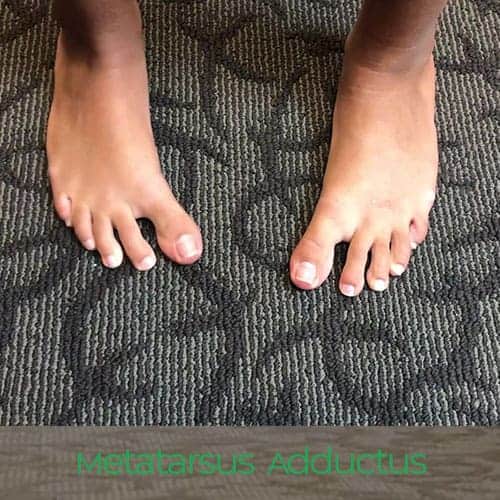
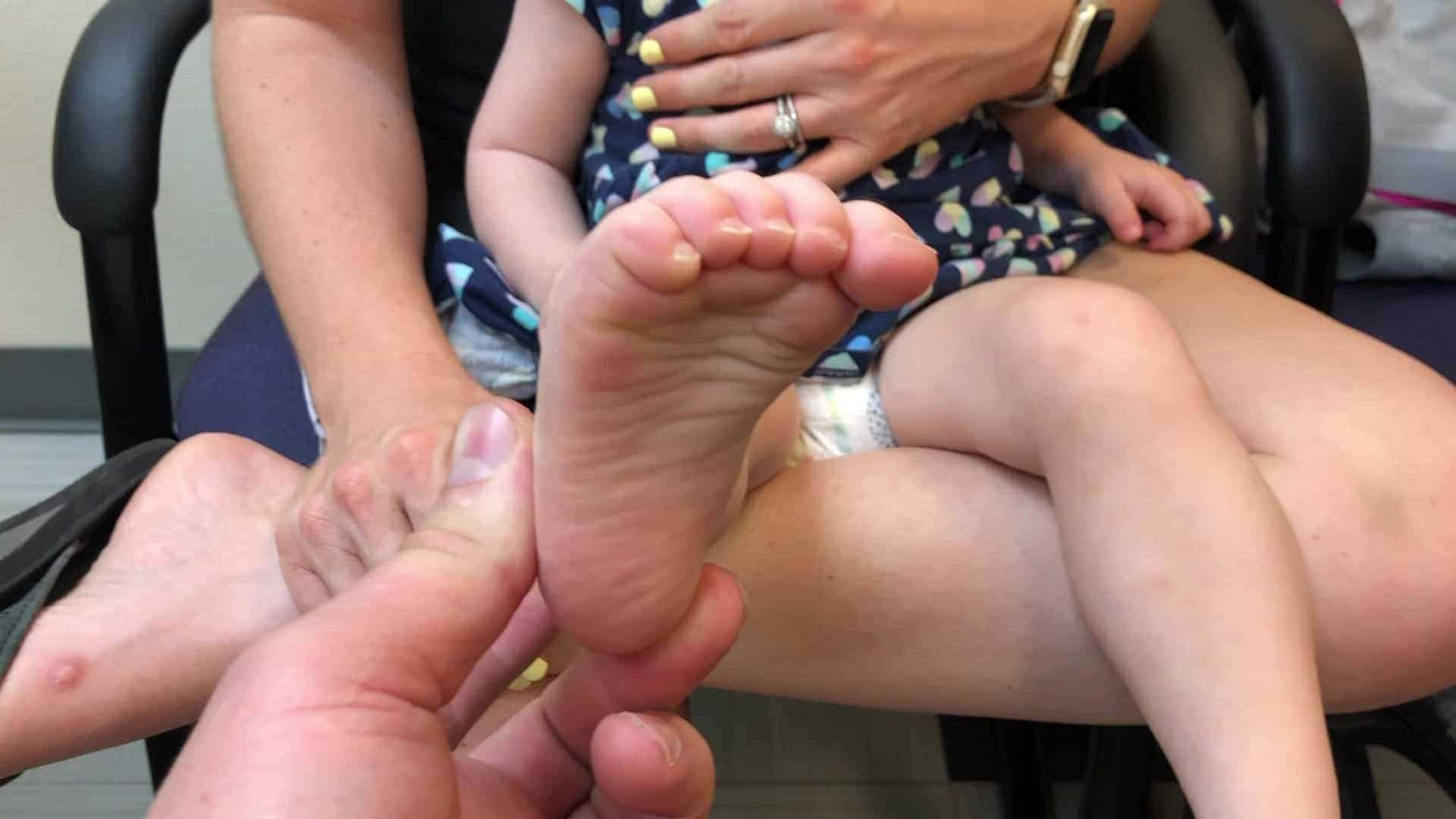
"When evaluating your child, If the knees are pointed forward during gait, then this is either a tibial torsion or a metatarsus adductus. To differentiate these, have the child sit in a chair and look at the bottoms of their feet.If you notice that their foot curves in, then most likely they have metatarsus adductus. In general, we find that children under the age of one, the most common culprit of intoeing seems to come from metatarsus adductus. In children between the ages of one and two, we commonly see tibial torsion as the predominant condition influencing intoeing. Femoral anteversion will often manifest in children older than four."
Dr. Mikkel Jarman
In-Toeing (Pigeon Toes) FAQ's
Parents often have similar questions when their child is dealing with in-toeing. Here are answers to some of the most common concerns about in-toeing (pigeon toes).
What is intoeing (pigeon toes)?
Intoeing, sometimes called being "pigeon toed," is when a child's feet point inward instead of straight ahead. It's fairly common, and mild cases generally resolve on their own. A child may walk this way from the start, or the pattern can develop later. Intoeing itself is painless, though pain can be associated with whatever underlying issue is causing it.
What causes intoeing in children?
Intoeing comes from one of three areas of origin:
- Femoral anteversion: a torsional pull from the hips that turns the knees and feet inward.
- Tibial torsion: a torsional pull from the lower leg (shinbone) that turns the legs and feet inward.
- Metatarsus adductus: a foot deformity originating in the forefoot, typically visible at birth.
What is femoral anteversion, and does it need treatment?
Femoral anteversion is an inward turning of the thighbone. It usually isn't obvious until a child reaches school age, and it nearly always corrects itself by age 9 or 10. Conservative treatment doesn't correct this type of intoeing — if a child has femoral anteversion along with severe deformity or gait issues, surgery to cut and rotate the femur into the correct position may be considered after age 10.
What is tibial torsion, and how is it treated?
Tibial torsion is an inward twist of the lower leg (shinbone). It typically improves gradually, with normal alignment usually in place by the time a child starts school. Like femoral anteversion, it doesn't respond to conservative treatments such as splints, physical therapy, or special footwear. If a child reaches age eight without improvement and has significant walking problems, surgery to rotate the shin bone may be recommended.
What is metatarsus adductus?
Metatarsus adductus is when the foot bends inward from the midpoint to the toes. It can be mild and flexible or more rigid, and it typically corrects itself by around 6 months of age. In cases of severe rigidity, casting and special shoes usually resolve the problem, and surgery is rarely needed.
Is metatarsus adductus the same as clubfoot?
No. Although severe cases of metatarsus adductus can resemble clubfoot, they aren't the same condition. Clubfoot nearly always requires treatment very soon after birth, while metatarsus adductus often improves on its own or with simpler conservative treatment.
Will my child's intoeing get better on its own?
Often, yes — all three types of intoeing tend to improve with growth: metatarsus adductus by around 6 months, tibial torsion by school age, and femoral anteversion by age 9 or 10. That said, early evaluation is still recommended, especially when intoeing is noticed in infancy with no improvement over time, since some cases benefit from earlier intervention.
Does intoeing cause pain, or affect walking and sports?
Intoeing on its own is painless. If your child is experiencing pain, it's more likely related to whatever underlying issue is contributing to the intoeing rather than the inward foot position itself, which is a good reason to have it evaluated rather than assumed to be unrelated.
Will my child need surgery for intoeing?
Surgery is uncommon and is only considered when a specific type of intoeing hasn't improved by the expected age and is causing significant gait problems or deformity — generally after age 8 for tibial torsion or after age 10 for femoral anteversion. Metatarsus adductus rarely needs surgery at all. An evaluation will determine which type of intoeing your child has and whether treatment beyond watchful waiting is appropriate.
When should I have my child's intoeing evaluated?
It's worth scheduling an evaluation if intoeing is noticed in infancy and isn't improving over time, if it's severe or rigid rather than flexible, or if your child has pain, a significant limp, or difficulty walking. An accurate diagnosis of which type of intoeing is present is the key first step to knowing what, if anything, needs to be done.
Your Child’s Feet Are Built for Life. We Help Keep Them That Way.


